Why European coaches need a GDPR-compliant WhatsApp tool
Your clients message you on WhatsApp because it is effortless. No app to download, no portal login, no email that sits unread for three days. For a coach or consultant, that immediacy is the whole point — the conversation is the relationship.
But there is a gap between "my clients message me on WhatsApp" and "I run my business on WhatsApp compliantly." If you are based in the EU, or you serve EU clients, that gap has a name: the General Data Protection Regulation. And most coaches are standing on the wrong side of it without realising.
This isn't a scare piece. It's a practical map of where the line is, why the personal WhatsApp app can't get you across it, and what a compliant setup actually looks like.
The problem with running a business on personal WhatsApp
The consumer WhatsApp app was built for chatting with friends. The moment you use it to book clients, store their phone numbers, discuss their health or finances, and follow up on payments, you are processing personal data in the GDPR sense — and you become a data controller with real obligations.
Here's what breaks quietly:
- No legal basis, no record. GDPR requires you to know why you're allowed to hold each piece of client data. Personal WhatsApp gives you no way to record consent or a contractual basis.
- No retention control. Client chats, phone numbers, and shared documents live on your phone indefinitely. GDPR expects you to delete data when you no longer need it.
- No separation. Your client's intake notes sit in the same app as your family group chat. If your phone is lost or seized, so is their data.
- You can't honour a data request. When a client asks you to export or delete everything you hold on them — their right under Articles 15 and 17 — scrolling through a chat thread is not a defensible answer.
The uncomfortable part
Using the personal WhatsApp app for client work also violates WhatsApp's own Business Terms. Meta reserves the right to ban numbers used for business on the consumer app. Compliance and account safety point the same direction here.
What GDPR actually asks of you
GDPR is less scary when you reduce it to the handful of things a regulator would actually ask about. For a solo coach or a small practice, it comes down to four questions.
1. What's your legal basis?
Every bit of processing needs a lawful basis under Article 6. For coaching, two matter most:
- Contract (Art. 6(1)(b)) — you need the client's number and notes to deliver the sessions they booked.
- Consent (Art. 6(1)(a)) — required separately if you want to, say, send marketing broadcasts or newsletters.
The key is that these are different bases. Booking a discovery call does not give you consent to add someone to a promotional broadcast list.
2. Can you delete on request?
When a client invokes their right to erasure, you need to remove their personal data across your systems — not just hide a chat. A compliant tool makes this a button, not an archaeology project.
3. How long do you keep data?
You should retain personal data only as long as you have a reason to. German tax law, for instance, requires invoice-related records to be kept for years — but a prospect who never booked shouldn't linger in your CRM forever.
4. Where does the data live, and who else touches it?
Every third party that processes data on your behalf (your CRM, your hosting, your payment processor) is a processor, and you need a Data Processing Agreement (DPA) with each. "I use WhatsApp" is not a DPA.
A useful mental model
GDPR isn't asking you to collect less — it's asking you to be deliberate. Know what you hold, why you hold it, and how a client can get it back or wiped. A good tool makes that the default instead of a chore.
The WhatsApp Business API changes the equation
Here's the part most coaches don't know: there are two WhatsApp products.
| Consumer app / WhatsApp Business app | WhatsApp Business Platform (Cloud API) | |
|---|---|---|
| Built for | Personal chats, tiny businesses | Businesses processing customer data at scale |
| Data processing terms | Consumer terms | Commercial terms with a proper DPA |
| Multiple team members | One phone | Shared inbox, role-based access |
| Consent & opt-out | Manual, ad hoc | Structured, logged |
| Deletion / export | Scroll and pray | Programmatic, per-contact |
The official WhatsApp Business API is the foundation a compliant setup is built on. It comes with commercial terms designed for exactly this — a real DPA, structured message templates that require opt-in, and the ability to build proper consent and deletion flows on top.
You don't interact with the API directly, though. You use a tool built on it. And that's where the choice actually matters.
What "compliant" looks like in a tool
When you evaluate a WhatsApp CRM as a European coach, look past the features and check for the compliance plumbing:
- Built on the official Business API — not a grey-market bridge to the consumer app. (Tools that automate the personal app risk getting your number banned and leave you non-compliant.)
- EU data hosting — your client data stays in the EU, with a signed DPA available.
- Encryption at rest — tokens and sensitive fields encrypted, not sitting in plain text.
- Per-contact export and deletion — so you can honour a subject access or erasure request in minutes.
- Separate consent tracking — booking a session and opting into marketing are recorded as distinct events.
- A clear retention story — you can see and control how long data is kept.
As an illustration, a compliant tool records consent as a structured, timestamped event rather than a vague memory of "they said it was fine":
{
  "contact_id": "c_8f3a...",
  "event": "marketing_consent",
  "granted": true,
  "basis": "Art. 6(1)(a)",
  "source": "booking_form",
  "timestamp": "2026-08-04T09:12:33Z"
}
That single record is the difference between "we have consent" and "we think we probably had consent." One of them survives an audit.
The goal isn't to turn a coach into a compliance officer. It's to make the compliant path the easy path — so doing right by your clients takes less effort than doing it wrong.
Where Chatydesk fits
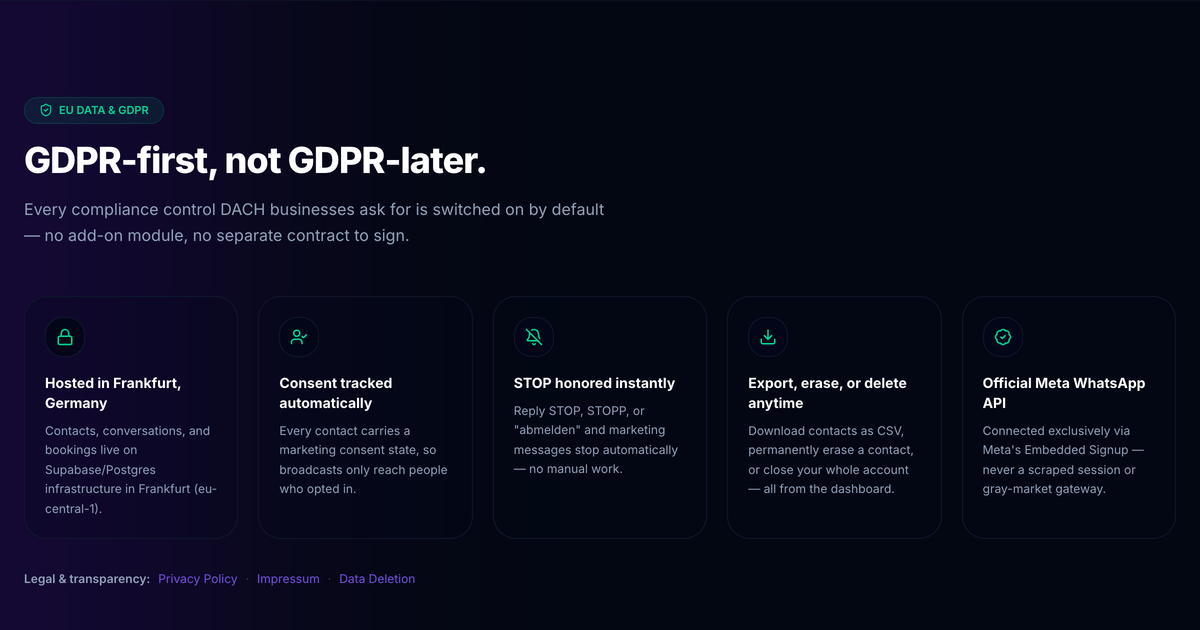
Chatydesk is built on the official WhatsApp Business API, hosted in the EU, with encryption at rest, per-contact data export and deletion, and separate consent tracking for bookings versus marketing — the checklist above, as the default. It gives a solo coach or a small practice a shared inbox, bookings, and payments on the number clients already message, without the compliance debt of the personal app.
If you're running your coaching business on WhatsApp today, the honest first step is a five-minute audit: what client data do I hold, where does it live, and could I delete it on request? If the answers make you wince, that's the gap this whole article is about — and it's a solvable one.
Next step
See how a compliant WhatsApp workflow feels in practice. Book a demo and we'll walk through bookings, payments, and data requests on a live inbox.
This article is general information, not legal advice. For your specific situation — especially around retention periods and DPAs — consult a data protection professional.
Frequently asked questions
Is it GDPR-compliant to run my coaching business on the personal WhatsApp app?
No. The consumer app gives you no way to record a legal basis, control how long data is kept, separate client data from personal chats, or honour an export or deletion request. Using it for client work also breaks WhatsApp's own Business Terms, which risks your number being banned. A compliant setup is built on the official WhatsApp Business API.
What is the difference between the WhatsApp Business app and the WhatsApp Business API?
The Business app runs on consumer terms, on one phone, with ad-hoc consent. The WhatsApp Business Platform (Cloud API) runs on commercial terms with a proper DPA, supports a shared inbox with role-based access, structured consent and opt-out, and programmatic per-contact export and deletion.
What makes a WhatsApp CRM GDPR-compliant?
It is built on the official Business API (not a grey-market bridge to the consumer app), hosts your data in the EU with a signed DPA, encrypts sensitive data at rest, supports per-contact export and deletion, tracks consent for bookings and marketing as separate events, and gives you a clear data-retention story.
Can a client ask me to delete their data, and can Chatydesk do it?
Yes. Under GDPR Articles 15 and 17 a client can ask you to export or erase everything you hold on them. Chatydesk supports per-contact export and deletion so you can honour the request in minutes, instead of scrolling through a chat thread.